Spotlight Case: Managing Evaporative Dry Eye & Meibomian Gland Dysfunction Using OPE® IPL and LLLT with Eye-Light®
A 53-year-old male patient with heavy daily digital screen exposure (>10 hours) presented with severe evaporative dry eye and advanced meibomian gland loss. Leveraging Espansione Group’s Eye-Light® platform—combining Optimal Power Energy (OPE®) Intense Pulsed Light (IPL) and Light Modulation® Low-Level Light Therapy (LLLT)—Dr. Vishal Arora (CMD, Aro Health; Head, Artemis Hospitals, Gurugram) achieved a threefold improvement in tear film stability and measurable meibomian gland morphological recovery across three treatment sessions.
Treating Evaporative Dry Eye Using Eye-Light® IPL + LLLT Therapy
A Case Study Highlighting the Role of Combined Photobiomodulation and Meibography
Overview
Evaporative dry eye driven by Meibomian Gland Dysfunction (MGD) is a leading cause of chronic ocular surface instability, particularly among patients with prolonged daily digital screen exposure. Early structural evaluation via non-invasive meibography paired with targeted IPL and LLLT therapy plays a pivotal role in restoring tear film homeostasis and improving gland morphology.
Patient Presentation
A 53-year-old male (Mr. RV) presented in April 2019 for dry eye evaluation, reporting daily digital screen usage exceeding 10 hours.
- Visual Acuity (with glasses): 6/6 (Right Eye), 6/7.5P (Left Eye)
- Intraocular Pressure (NCT): 11 mmHg (Right Eye), 11 mmHg (Left Eye)
- Eyelids & Adnexa: MGD+ in both eyes
- Tear Film Break-Up Time (TFBUT): 3 seconds (Right Eye), 3 seconds (Left Eye)
- Conjunctiva: Clear bilaterally
- Primary Diagnosis: Evaporative Dry Eye secondary to Meibomian Gland Dysfunction
Diagnostic & Treatment Findings
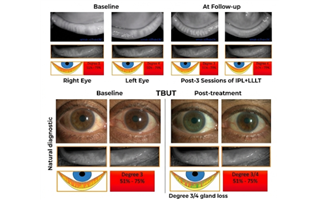
Baseline Meibography (me-check®)
- Right Eye: Degree 3 meibomian gland loss (51%–75% dropout)
- Left Eye: Degree 4 meibomian gland loss (>75% dropout)
- Administered 3 sessions of combined IPL + LLLT using the Eye-Light® system, spaced 2 weeks apart.
- Initial supportive regimen included Osmodrops eye drops (6 times daily for 1 month), Oloris eye drops (1-0-0 daily for 30 days), and Cornigel eye ointment at bedtime.
Post-Treatment Evaluation (18-Sep-2019)
| Clinical Parameter | Baseline (Apr 2019) | Post-3 Sessions (18-Sep-2019) |
|---|---|---|
| Visual Acuity (Glasses) | RE: 6/6 | LE: 6/7.5P | RE: 6/6 | LE: 6/6 |
| IOP / NCT (mmHg) | RE: 11 | LE: 11 | RE: 10 | LE: 12 |
| TFBUT | RE: 3 sec | LE: 3 sec | RE: 9 sec | LE: 10 sec |
| OSDI Score | Symptomatic Evaporative Dry Eye | 0 (Complete symptomatic resolution) |
| Meibography (me-check®) | RE: Degree 3 (51%–75%) LE: Degree 4 (>75%) |
RE: Degree 3 (51%–75%) LE: Degree 3 (51%–75%) — improved morphology |
Clinical Insights
Combined IPL and LLLT therapy via Eye-Light® enabled non-invasive management of advanced MGD, achieving a threefold increase in tear film break-up time (from 3 seconds to 9–10 seconds) and an OSDI score of 0. Follow-up meibography confirmed structural improvement in meibomian gland morphology, particularly in the left eye, which improved from Degree 4 (>75% loss) to Degree 3 (51%–75% loss).
“I would highly recommend people to invest into dry eye diagnostic and treatment. Eye-Light is one of the best platforms to treat dry eye.” — Dr. Vishal Arora, CMD Aro Health & Head, Artemis Hospitals Gurugram
Outcome & Follow-Up
- Transitioned to maintenance therapy: Osmodrops / Extralube eye drops (4 times daily for 3 months), Oloris KT or Acupat (twice daily for 1 month), Lacrigel (HPMC 2% w/v) ointment at night for 1 month, and Evolve Eye Mask at night for 3 months.
- Advised strict adherence to the 20-20-20 digital screen rule (20-second break every 20 minutes) and environmental protection against smoke, sun, and dust.
- Patient reported high satisfaction and complete relief from dry eye symptoms following the 3-session protocol.
Conclusion
This case underscores the clinical value of pairing objective meibography diagnostics with combined IPL + LLLT therapy using Eye-Light®. By addressing both tear film instability and underlying meibomian gland dysfunction, clinicians can achieve rapid symptomatic relief and measurable structural recovery in patients with evaporative dry eye.